
October 30, 2025
Where the Land Breathes with the Sea
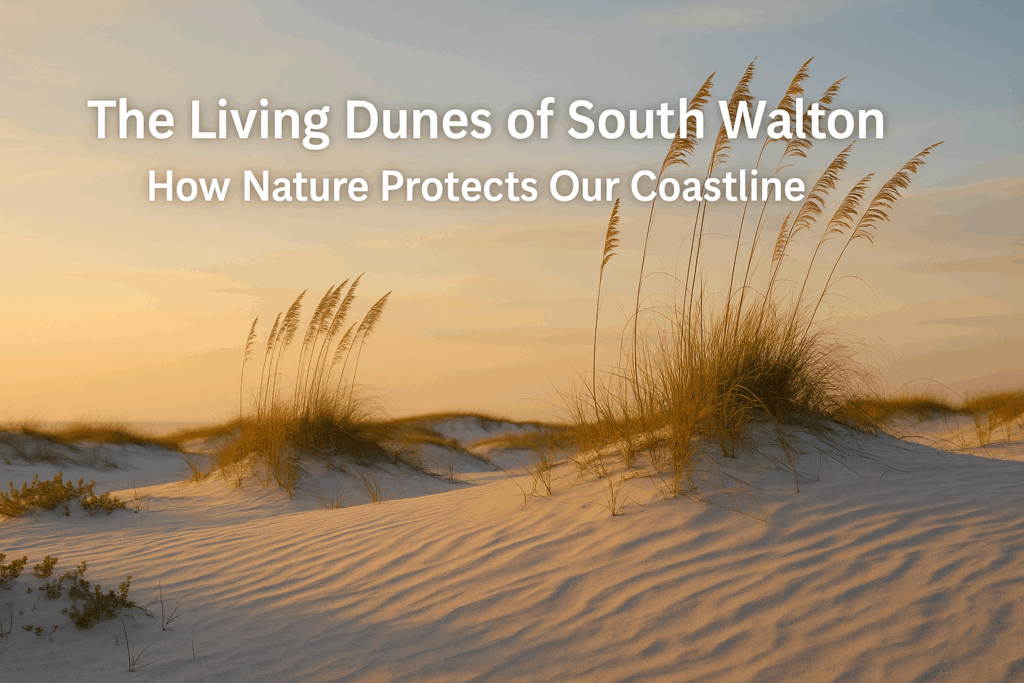
Stand anywhere along the beaches of South Walton, and you’ll notice something remarkable before you ever see the water — the dunes.
They rise in soft, sweeping curves behind the beach, crowned with sea oats that whisper in the wind. They look serene, almost decorative, but these rolling hills of sand are not scenery — they’re sentinels.
The dunes are alive. They shift, breathe, and rebuild. They protect homes, wildlife, and entire ecosystems from the restless energy of the Gulf. And like all living things, they depend on balance — and our respect — to survive.
How the Dunes Were Born
The story of South Walton’s dunes began thousands of years ago, when ancient rivers carried fine quartz sand from the Appalachian Mountains down to the Gulf. The same geological process that gave Miramar Beach its bright white sand also built South Walton’s dunes, one grain at a time.
Wind, waves, and storms sculpted those sands into ridges. Grasses took root, holding them in place. Over centuries, these dunes grew layer upon layer, forming one of Florida’s most dynamic natural defense systems.
Unlike static landforms, dunes are constantly in motion — they erode, rebuild, and shift with each season. To walk among them is to witness time itself, reshaping the edge of a continent.
The Anatomy of a Dune
A coastal dune isn’t just a pile of sand — it’s a complex, layered ecosystem. Each zone, from the foreshore to the backdune, supports different forms of life.
- The Fore Dune — Closest to the Gulf, this zone faces the brunt of salt spray and storm winds. Plants like sea oats, beach morning glory, and seashore paspalum thrive here, using deep roots to anchor the sand.
- The Secondary Dunes — Set slightly inland, these are taller and more stable. You’ll find gulf bluestem, sand live oak, and saw palmetto, forming a transitional habitat that shelters small animals and acts as a windbreak.
- The Back Dunes — These oldest dunes lie farthest from the beach and often support shrubs and even pine forests. They protect wetlands and freshwater lakes that form behind them.
Together, these layers create a living barrier that absorbs storm energy, filters rainwater, and prevents inland flooding. When a hurricane hits, dunes literally take the hit for us.
Sea Oats: The Unsung Heroes
If dunes are the body, sea oats are the bones. These tall, golden grasses do more than wave in the breeze — they are the engineers of stability.
Sea oats have extensive root systems that can grow 20 to 30 feet deep. When wind blows sand around, their roots trap and hold it, helping dunes grow upward and outward.
Every time a seed takes hold, it adds another thread to the dune’s structure. That’s why walking through sea oats is discouraged — a single footprint can break a root system that’s taken years to form.
Florida law protects these plants for good reason: without them, dunes unravel.
A Home for the Wild
South Walton’s dunes are more than geological marvels — they’re living habitats teeming with wildlife.
Endangered species like the Choctawhatchee beach mouse and loggerhead sea turtle depend on them. Beach mice burrow into the dunes for shelter, while turtles nest in their soft slopes under moonlight.
The dunes also host a variety of birdlife — snowy plovers, least terns, and black skimmers — all of whom rely on the dunes’ elevation and seclusion to safely breed.
When people or pets trample these fragile areas, they can inadvertently destroy nests or crush burrows invisible from above. To the untrained eye, a dune looks like a hill. To its residents, it’s home.
The Dunes and the Storms
Every storm season, South Walton residents hold their breath as the Gulf’s moods shift. Hurricanes and tropical systems batter the shoreline, testing the dunes’ resilience.
The dunes don’t resist these forces — they work with them. When high waves crash in, dunes erode strategically, absorbing the impact and sacrificing sand that will later be redeposited by wind.
Think of dunes as shock absorbers for nature. They take the beating so that roads, homes, and inland habitats don’t have to.
After the storm, sea oats and wind rebuild what was lost. It’s a patient process, a rhythm of loss and renewal that defines the Emerald Coast’s survival.
Man vs. Dune: A Delicate Balance
As South Walton has grown in popularity, its dunes have come under new kinds of pressure. Boardwalks, beachfront homes, and foot traffic all threaten to destabilize the sand.
Development near the dunes doesn’t just affect the view — it changes how sand moves, how vegetation grows, and how water drains. Without careful planning, even one badly placed walkway can interrupt dune growth.
That’s why Walton County’s Coastal Protection Program enforces strict dune management and restoration efforts. Fences, elevated boardwalks, and restricted access zones aren’t inconveniences — they’re shields that keep the ecosystem alive.
Dune Lakes: The Hidden Water Worlds
One of South Walton’s most fascinating natural features lies behind its dunes — the coastal dune lakes. These rare freshwater lakes, found in only a handful of places worldwide (including Madagascar and Australia), form where dunes trap rainwater and groundwater near the coast.
In South Walton, these lakes — like Western Lake and Camp Creek Lake — occasionally break through their dune barriers, creating temporary connections to the Gulf.
These “outfalls” flush nutrients and refresh both ecosystems, creating a dynamic cycle of renewal. Without healthy dunes, these lakes would erode away.
Restoration and Protection Efforts
Thankfully, South Walton’s community takes dune preservation seriously.
Local organizations, including The Choctawhatchee Basin Alliance (CBA) and South Walton Turtle Watch, work with volunteers and scientists to monitor dune health and replant vegetation after storms.
Replanting projects use native species like sea oats, railroad vine, and dune panic grass — all chosen for their resilience and deep root systems.
Each small restoration helps rebuild the barrier, grain by grain. It’s slow work, but it’s the kind that pays off every hurricane season.
How Visitors Can Help
Dune protection isn’t complicated — it just takes awareness.
- Stay on designated walkovers. Foot traffic erodes sand and destroys plants faster than storms do.
- Avoid picking sea oats or flowers. These plants are protected, and their seed heads are crucial for new growth.
- Respect fencing and signage. They’re not there to block the view; they’re there to keep the dunes breathing.
- Keep lights low at night. Artificial light disorients sea turtles and other nocturnal species that rely on moonlight.
- Join a cleanup or restoration day. Local volunteer events are often listed by the Choctawhatchee Basin Alliance and Walton Outdoors.
When visitors participate, they become part of the dunes’ long-term story — protectors instead of passersby.
The Science of Stillness
What’s most extraordinary about South Walton’s dunes isn’t their size or beauty — it’s their silence.
They don’t roar like waves or move like tides, yet their slow-motion choreography keeps the coast alive.
They show that nature doesn’t have to be loud to be powerful.
It can whisper in the rustle of grass, shift quietly under moonlight, and still hold back the sea.
Frequently Asked Questions
Q: Why are dunes important?
A: Dunes protect inland areas from storm surge and erosion, provide wildlife habitat, and help maintain the natural shape of the coastline.
Q: Can I walk on the dunes?
A: No. Walking on dunes damages vegetation that holds the sand in place. Always use marked beach access points.
Q: What plants grow on dunes?
A: Common dune plants include sea oats, dune panic grass, beach morning glory, and sea purslane. These species have deep roots that stabilize sand.
Q: What causes dunes to erode?
A: Natural processes like storms and wind, as well as human activity such as trampling or construction too close to the dune line.
Q: How can I help protect them?
A: Stay off dunes, avoid disturbing plants, and support restoration projects or local conservation groups.